| Reminiscences of my Irish Journey
in 1849 by Thomas Carlyle Published by Gilbert & Rivington, London, 1882 |
![]() |
| Thomas Carlyle, a
well-known philosopher of the Victorian age,
travelled across Ireland during the July of 1849 alongside
the nationalist Charles Gavan Duffy. In spite of his choice
of companion, Carlyle himself proved to be a staunch supporter of the
Union. While the following is in
many ways a valuable account, Carlyle's attitude towards the famine
victims often makes chilling reading. Carlyle's letters during his Irish Journey can be read here. A commentary on the book is available here. Return to the Documents or Main page. |
| INDEX |
|
| Preface (J.A. Froude, 1882). | |
| Saturday 30th June: | Steamer crossing begins. |
| Sunday 1st July: | Crossing continues; man goes overboard. |
| Monday 2nd July: | Carlyle meets two sisters from Ennis. |
| Tuesday 3rd July: | Steamer passes by Vineger Hill; Carlyle arrives in Dublin. |
| Wednesday 4th July: | Carlyle meets his acquaintances in Dublin, including Duffy. |
| Thursday 5th July: | More appointments with the Dublin elite. |
| Friday 6th July: | Visits a Model School; dinner at a country house. |
| Saturday 7th July: | Royal Irish Academy, dinner with Lord Hutton at Howth. |
| Sunday 8th July: | Kildare; first real sight of famine victims. |
| Monday 9th July: | Glendalough. |
| Tuesday 10th July: | 'Commoners' at Kildare; more detail on Glendalough, esp famine victims. |
| Wednesday 11th July: | Visits poorhouses and workhouse at Kilkenny. |
| Thursday 12th July: | Waterford. |
| Friday 13th July: | Catholic charity school; Dungarvan; Dromana. |
| Saturday 14th July: | Melleray Monastery. |
| Sunday 15th July: | Youghall. |
| Monday 16th July: | Leaves Youghall for Cork. |
| Tuesday 17th July: | Dinner at Denny's cottage: 'black thorn stick' ritual. |
| Wednesday 18th July: | To Killarney; sees people begging, funeral procession. |
| Thursday 19th July: | Visits farm, National School, goes boating on a lake. |
| Friday 20th July: | Meets Mr Boyne, a land-improver. |
| Saturday 21st July: | Goes to Lady Beecher's at Ballygiblin |
| Sunday 22nd July: | Witnesses an eviction; goes to church and writes critically about religion. |
| Monday 23rd July: | Limerick. Meets the persecutors of the Young Irelanders. |
| Tuesday 24th July: | Describes Limerick. |
| Wednesday 25th July: | Stays with Sir Richard Bourke. |
| Thursday 26th July: | Describes poverty in the countryside and a workhouse. |
| Friday 27th July: | Galway. Describes 'wild' Claddagh, religious buildings, people's admiration for Duffy. |
| Saturday 28th July: | Travels to Westport, views workhouse, 'the acme of human swinery'. |
| Sunday 29th July: | Ballina. Visits workhouse. |
| Monday 30th July: | Scotch-shop; travels to Sligo, sees child beggars and cottages emptied by eviction. |
| Tuesday 31st July: | Queen Mab's grave; problems with mines/public works. |
| Wednesday 1st August | Travels to Ulster. |
| Thursday 2nd August: | Travels around countryside with Lord George; criticism of the Irish. |
| Friday 3rd August: | Further details of Lord George's reforms; more criticism of the Irish. |
| Saturday 4th August: | Meets a peasant farmer; travels to Derry. |
| Monday 5th August: | Temple Moyle Agricultural School; meets Londoner who is encouraging emigration. |
| Tuesday 6th August: | Political talk at breakfast; returns to Scotland. |
|
Sunday
morning (1 July)
at 7 came
on deck: beautifully sunny morning, Isle of Wight, Ventnor region lying
close
at hand, and the ship motionless waiting for the turn of the tide
– wind had
gone round from east to west in the night: we hung for about an hour
with little,
at first with next to no motion, opposite that southwest region of the
little
Island. The special localities, none of which were known to me
beforehand, I
did not get committed to memory. A straggling hamlet (perhaps about
Dunnose, I
can’t now find on the map any name that fixes itself as the
name then given me)
with a kind of bay and clayey unbeautiful coasts, this stood distinct;
less so
other straggling human objects; and now only Ventnor itself figures as
absorbing the whole vivid past of the scene. A steepish slope, very
green but
rather treeless; houses and little gardens sprinkled over a good part
of it,
connected by oblique paths; grass-surface very beautiful everywhere,
shrubberies apparently flourishing; a pleasant group of dwellings hung
out there
against the morning sun, - and one of them, I knew not which, had been
John
Sterling’s last dwelling! I looked intently, with many
thoughts. Bonchurch not
visible now – had it been? I knew also (what was curious to
think of) that John
Forster, little dreaming of my whereabout, was in one White’s
at Bonchurch,
down from N.B. – After 3 days more there is not even a pencil scrap, nothing but the letters to help me decipher what was the exact day of this or that occurrence still remembered by me. It
turned out now that there had
a man been lost last night. The
good
old Captain so reported it. On Saturday evening, most of the poor Irish
wretches of “invalids” got more or less completely
drunk; some of them even on
entering, had needed no completing. One of them a lean, angry,
misguided,
entirely worthless looking creature, age perhaps 40, came staggering
upon the
quarterdeck, and made a turn there: turn nearly completed, he came
right upon
the captain who of course ordered him off, - which order,
tho’ given mildly
enough the poor drunk wretch felt to be insulting to his honour, and
swore
fiercely not to comply with. A scuffle had ensued (Captain’s
hand got
“twisted”): all of us started up to conjure the
poor wretch & c.; he did then
turn off, abashed, perhaps repentant, had taken more drink for
consolation; was
“last seen about “Portland
Bill”: it was on
awakening from one of my deck sleeps, well on in the afternoon that
this
object, a muddy-beached little Island, I found, - perhaps an Island
only at
high tide: - shaped rather like a battle bill
– was that the origin of the name? From this
point the Coast continued our
neighbour again; by degrees Dorsetshire passed, and then |
|
All
busy when I came on deck;
sunny morning, boxes, bales, persons getting or got on board; soon
sail; have
seen nothing of Plymouth, see little even of the harbour except
confusion of
ropes and ships; - size of it guessable at less than I expected. Tract
of town
(Catwater they called it?) stretching back on the right as we sailed out; buildings like public storehouses,
or official houses, farther down; two neat women step hurriedly on
board there; misventurous
Irish-women,
giving up
their plan of emigration to Australian, and cowering back to Ennis in
Clare, as
I afterwards learned; sisters, Misses Hewit by name. Breakwater a stone
glacis,
with light-tower (perhaps cannon-tower too) and small esplanade at the
end, some
frigates scattered about; it was Cornish
coast, as that of
Devonshire had been, gnarled rocky; indented all along, harbour and
sound (when
once you had “opened” it) at the bottom of each
little bay “Pol” – something or
other, when you asked the name. An interesting event to me. Looe:
“that is
Looe,” that strait hardly perceptible crack or notch in the
rocks there. – Poor
C. Buller, poor old years of his and mine! Fowey-Harbour entrance was
marked by
white spots, a couple, painted on
the
rocks; not find it otherwise. Toots preying on
the new comers. “Hum-m-m.
Drum-m-m!” with a strong Irish intonation in
it. Many trim sloops or one pattern, with red sails and conspicuous
label
(“P.H. No. 1” & c.? Something like that)
were nimbly cutting about:
“Pilchard-boats, sir!” All busy here, crowded
steamer crossed to us on the
left: pleasure-trip, I
might, had I foreseen that
latter fact, have gone ashore to see “Barclay Fox”
and Our 2 Irishwomen “from Ennis in Clare” with their clean summer-bonnets (mere clean calico, folded full over paste board, with a tack or two; much admired by me) had come to the quarter-deck; wished evidently to be spoken to; were by me, after others of us. Father had been a Lieutenant of foot with pension, mother too with pension; both being dead, resources were all out: parson had advised emigration, “free passage to Australia” was certain if we would deposit £12 in advance; deposited, sold off, came to Plymouth, found the “free passage” a passage among parish paupers, and shrieked (of course) at the notion of it! Officers had been extremely helpful and polite; got us back, with difficulty, our £12; and here we are, wending our sad way home again! A more distressing story I had not lately heard. For both the women, “ladies” you could not have hesitated even in the poor-house to call them, were clearly of the superior faculty and quality: the elder some 45 perhaps, a rugged brave-looking woman; the younger delicate, graceful, and even still beautiful, tho’ verging towards middle-age also. The two unfortunates, was there nothing other for them by way of career in the world but this! The younger was quite pleasant company; but at “the Lizard” or earlier began to grow sick, grew ever sicker, and I had to lead her to her place, a horrible den called “Second Cabin,” and there leave her sister and her. Ill-nature of the stewardess, tiff between the good old captain and her because of these poor Miss Hewits. “Bring me our basket, pray sir! Stewardess will give it you!” were the last words of the elder from her dark den. Stewardess knew nothing of their basket, not she; old captain awoke from his after-dinner nap, reproached the woman for her greedy hard character, ordered here to “know” the basket, which, with very angry tears, assisted by me and my soothing eloquence, the creature at least did. Base, in many cases, under certain aspects, is the mind of man! The
“ As there was nothing to be seen on deck but the dim tumult of sea and sky, I suppose I must have gone early to bed: I can remember shutting my little cabin door, (for the harsh stewardess, in hope probably of a shilling, had volunteered to make a bed for me in the place where I had found refuge the night before) with a satisfied feeling, and turning in with great hope: but, alas, it proved far otherwise. My first experience in the new bed was a jolt that nearly threw me out: the wind had risen, was still rising; the steamer pitched, rolled, tumbled, creaked and growled: doors banging, men’s feet and voices sounding, and the big sea booming and roaring: not a wink of sleep could be had all night, hardly could one’s place in bed be maintained. Some time, perhaps between 3 and 4 I went on deck to smoke; a wild wet stormy dimness everywhere; the mate dripping from every angle of his face and person – with thin wet shoes on, I remember – approached my shelter, talking sea stoicisms to me, admitting that it was a roughish night: noticeable fellow this; very civil, very good-humoured, sliding about (for he trailed his limbs and feet with thin shoes) to put this and that detail in order always; voice thin, creaky, querulous – hesitatory, and as if it couldn’t be troubled to speak; a rocking, sliding, innocent-hearted “sea-pedant” (as such I had classed him); with lips drawn in, puckered brow, and good humoured eyes pretending to be wearier than they were; came from the Medway, had been wrecked, traded to Aberdeen, was now puddling about in these seas; - may he prosper, poor fellow! I flung myself next on the sofa, under miscellaneous wrappage, and did then get some stony sleep till the morning fairly broke. |
|
Tuesday 3rd July On
deck between 8 and 9, all
hands looking out for “the Tuskar” when doing
nothing else; old captain and a
wretched passenger or two trying to walk the
quarter-deck (impossible for any two-footed
land animal); big sheets of spray dashing over them from time to time.
A wild
grey tumult; sight and sound everywhere of the rather dismal sort in
sea and in
sky. One ship or perhaps two at various times visible; elsewhere no
Tuskar, no
motion that was not of the chaotic
powers. Sailors made a wave or motion or sound of some sort from the
platform,
Captain too looked; Tuskar at last! In a few instants more I also could
see it;
white pillar or tower rising steady amid the tumult of the waters,
strange and
welcome; some 12 miles off, they said. We turned now gradually to the
right:
for Arklow head, for Wicklow do., then was “ Imperial-Hotel people, warned I suppose by Fitzgerald (Miss Purcell the proprietress’s nephew) had brightened up into enthusiastic smiles of welcome at the sound of my name: all was done for me then that human waiterage in the circumstances could do; I had a brisk-eyed deft Irish youth by way of special attendant, really a clever, active, punctual youth, who seemed as if he would have run to the world’s end for me at lifting of my finger: he got me cloakpins (my little bedroom the “quietest” they had, wanted such); bath tubs, attended to my letters, clothes, messages, waited on my like a familiar fairy. Could they have got me a room really “quiet,” where I might have really slept, all had been well there. But that was not possible; not there, nor anywhere else in inns. One’s “powers of observation” act under sad conditions, if the nerves are to be continually in a shatter with want of sleep and what it brings! Under that sad condition, as of a gloomy pressure of waking nightmare, were all my Irish operations, of observation or other, transacted; no escape from it; take it silently therefore, say nothing more of it, but do the best you may under it as under a law of fate. About 10 at night, still writing letters, I received “John O’Hagan’s” visit; a note from Duffy[1], who was dining there, had lain waiting for me before – brisk innocent modest young barrister, this John O’Hagan[2]; Duffy’s sister-in-law did by no manner of means let rooms; so her offer of one, indicated in Duffy’s note, had to be at once declined: Duffy himself “would be here in half an hour”. Wrote on to my mother or to Jane: Duffy came soon after the time set; drank a “glass of lemonade” from me, I a glass of punch; took my letters of introduction home with him to scheme out a route, gave me a road series “drive here first, then there, then &c” from Dublin introductions on the morrow; and after a silent pipe I tumbled into bed. Breakfast in the Public room: considerable company; polite all, and less of noise among them than when I was formerly there: arrangements all perfect; “toasted bacon”, coffee, toast, all right and well served – No letters for me at the Post-Office! strange, but no help. Car (“a shilling an hour”) aboutWhat people called, what bustle there was of cards and people and appointments and invitations in my little room, I have quite forgotten the details of (letters indicate more of it perhaps): what I can remember is mainly what I did, and not quite definitely (except with effort) all or the most of that. Notes
and visitors, hospitable
messages and persons, Macdonnel, Coll. Foster, Dr. Kennedy –
in real truth I
have forgotten all the particulars;
of Thursday I can remember only a dim hurly-burly, and whirlpool of
assiduous
hospitable calls and proposals, till about 4 o’clock when a
“Sir Philip Crampton,”[7] by no means the most notable of my
callers, yet now the most
noted in my memory, an aged, rather vain and not very deep-looking
Doctor of
Physic, came personally to “drive me out,”
– drive me to the Phoenix Park and
Lord Lieutenant’s, as it proved. Vapid-inane
looking streets in this Dublin, along the quays and
everywhere; sad defect
of wagons, real business vehicles
or
even gentlemen’s carriages; nothing but an empty whirl of
street cars, huckster
carts and other such “trashery.” Sir P’s.
talk, of Twistleton mainly – Stokes’s
dinner was well
replenished both with persons and other material, but it proved rather
unsuccessful. Foolish Mrs Stokes, a dim Still
in the bath-tub, when my
waiter knocked at the door, towards 9; and so soon as let in, gave me a
letter
with notice that some orderly, or heidue, or I know not what the term
is, was
waiting in some vehicle for an answer. Invitation from Lord Clarendon
to dine
with him on Saturday: here was a nodus! For not having slept, I had
resolved to
be out of Dublin and the noise without delay; Kennedy had pressed me to
his
country-house for a dinner on Saturday, and that, tho’ not
yet in words, I had
resolved to do, his hospitality being really urgent and his place
quiet; - and
now has the Lord Lieutenant come, whose invitation abolished
by law of etiquette all others! Out of the cold bath,
on
the spur of the moment, thou shalt decide, and the heidue waits! Polite
answer
(well enough really) that I am to quit Fellows
of Trinity, breakfast and
the rest of it accordingly took effect: University
after, along with
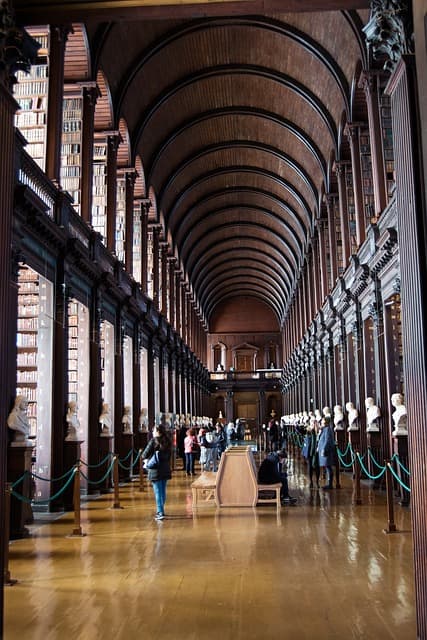
these two fellows: library
and busts;
Museum, with big dark Curator Ball in it; many knick-knacks –
Skull of Swift’s
Stella, and plaster-cast of Swift: couldn’t write
my name, except all in a tremulous scratchy shiver, in
such a state of
nerves was I. Todd had, by appointment, been waiting for me; was gone
again.
Right glad I to get home, and smoke a pipe in peace, till Macdonnel (or
somebody) should come for me! – Think it was this day I saw
among others
Councillor Butt, brought up to me by Duffy: a terrible black burly son
of
earth: talent visible in him, but still more animalism; big bison-head,
black,
not quite unbrutal: glad when he
went
off “to the Galway Circuit” or whithersoever.[10] Sad
reflexions upon About
4 p m as appointed,
Macdonnell with his car came.[11] “Son of a United
Irishman”, he too. Florid
handsome man of 45, with grey hair, keen hazel eyes, not of the very best expression: active, quick,
intelligent, energetic, with something smelling of the Hypocrite in
him,
disagreeably limiting all other respect one might willingly pay him. Talis qualis, with him through the
Streets. Glasnevin toolbar, woman has not
her groat of change ready; streaks of irregularity, streaks of squalor
noticeable in all streets and departments of things. Pleasant old country-house; excellent quietly genial and hospitable landlord: dinner pleasant enough really. McDonnell sat by me, somewhat flashy; Larcom opposite, perhaps do. but it was in the English style. Ancient Irish gentn. were of really excellent breeding, yet Irish altogether: these names quite gone (if ever known according to the underbreath method of introduction), their figures still perfectly distinct to me. In white neck cloth, opposite side, a lean figure of sixty; wrinkly, like a washed blacksmith in face, yet like a gentn. too, - elaborately washed and dressed , yet still dirty-looking; talks of ancient experiences, in hunting, claret-drinking, experiences of others his acquaintances, all dead and gone now, which I have entirely forgotten; high Irish accent; clean-dirty face wrinkled into stereotype, of smile or of stoical frown you couldn’t say which: that was one of the ancient Irishmen; who perhaps had a wife there? The other, a more florid man with face not only clean but clean-looking, and experiences somewhat similar; a truly polite man in the Irish style: he took me home in his car. Sir Dn. had handed me a general missive to the Police Stations “Be serviceable, if you ever can, to this Traveller,” – which did avail me once. At home lies Kennedy’s letter, enjoining me to accept the Lord Lieutenant’s dinner, whither he too is going; which I have already refused! What to do to-morrow night? Duffy is to be off to Kilkenny; to lodge with “Dr. Cane the Mayor”; who invites me too (Duffy, on the road to O’Hagan’s breakfast, shewed me that), which I accept. |
|
Wet
morning; wait for Kennedy’s
promised car, - to breakfast in the Zoological gardens. Smoking at the
door,
buy a newspaper, old hawker pockets my groat, then comes back saying
“Yer Hanar
has given me by mistake a threepenny!” Old knave, I gave him
back his
newspaper, ran up stairs for a penny, - discover that the threepenny
has a hole
drilled in it, that it is his, - and that I am done! He is off when I
come down
– Petrie under an umbrella, but no Kennedy still. We call a
car, we two; I give
him my “Note to Chambers Walker, Barrister,” whom
he knows, who will take me up
to at Larcom
next comes: for an hour
and half in Board of Works with him. Sir W. Petty’s old survey of Irish lands (in another
office from L’s); Larcom’s new
one, very ingenious; coloured map, with dots, figures referring you to
tables,
where is a complete account of all estates, with their pauperisms,
liabilities,
rents, resources: for behoof of the Poor law Commrs. and their
“electoral
divisions”; a really meritorious and as I fancy most valuable
work. Kirwan a
western squire accidentally there; astonished at me, poor fellow, but
does not
hate me, invites me even. Larcom to Hotel door with me: adieu, adieu!
To the
Hotel people too, who have done all things zealously for me, and even
schemed
me out a route for the morrow (wrong,
as it proved, alas!) I bid affecting adieus; and Ingram and Hancock
bowl me off
to the Howth Railway. Second-class, say they, but gentn. tho’
crowded: Escorted
by Hancock and young
Hutton am set down at Imperial Hotel, and thence my assiduous Familiar
brings
out luggage, in a car to Kildare Railway Station, (in the extreme west,
-
King’s or Template-bridge, do they call it?): three quarters
of an hour too
soon; rather wearisome the waiting. Fields all about have a weedy look,
ditches
rather dirty; houses in view, extensive some of them, have a patched
dilapidated air – limepointing on roofs
(as I gradually found) is uncommonly frequent in Ireland; do.
white-washing to
cover a multitude of sins: grey time-worn look in consequence
– lime is
everywhere abundant in Start
at last: second class but not quite
Gentn this time; plenty of room
however. Irish traveller alone in
my compartment; big horse-faced
elderly; not a bad fellow (a Wexforder?) – for Kildare,
as I entered it
looked worse and worse: one of
the wretchedest wild villages I ever saw; and full of ragged beggars
this day
(Sunday), - exotic altogether, “like a village in Tuesday
10th July.
Love, the Scotch farmer; excellent farming. Gentn (Burrowes) that
wouldn’t
allow draining; 800 people took the
Common; priest had petitioned Peel 10
years ago, but took no notice; peasant vagrants did,
and here their
cabins and grottos all are. Fitz’s
brother (a useful good servant) has a cabin and field here, with wife
in it;
good ground if it were drained. All Commons have been settled that way;
once
they were put away from, and the ditches levelled twice
(so said our first carman, a fine active lad), the third time it held, and so they stay.
O’Connor (Mrs Purcell’s brother) a smart dandyish
landlord, complained
dreadfully of these “Commoners” now mostly paupers;
nobody’s property once, now his
(to
fen). All creatures, Love among the rest, cling to the potatoe, as the
one hope
or possibility they have or ever dream of; look upon the chance of
failure, as
our Sulky did upon the stone “perhaps I’ll get over
it.” In the afternoon
Curragh of Kildare, best of race courses, a sea of beautiful green
land, with
fine cropt furze on it here and there, a fine race-stand (like the best
parish
church) at one end, saddling house & c; racing apparatus
enough; and work for about 10,000
people if they
were set to it instead of left to beg, (circle of 3 miles, 4,000 acres,
look?)
Newbridge village and big barrack; Liffey both at Kilcullen and it; Monastery, Mrs P. saluted priest; people
all lounging, village idle, silent, many houses down.
– Railway, whirl of dust, smoke and screaming
uproar, past
Kildare again, past Athy (A-thigh)
old walls, now a village, Wexford hills on this hand, Q’s
County hills on that:
good green wavy country alternating with detestable bogs to Carlow
– saw into
the grey old hungry-looking stones as we whirled past in the evening
sun –
Railway Station, broken windows there (done by mischievous boys),
letters
knocked off & c, now and then all the way from Dublin. Car at
Bagnalstown,
eloquent beggar. “More power to you “wherever you
go! The Lord Almighty “
preserve your honor from all sickness and “hurt and the
dangers of the year!”
&c. &c. Never saw such begging in this world; often get
into a rage at
it. On to Kilkenny (over the Barrow & c); noisy vulgar fellow,
talks, seems
to know me. Castle Inn door; Dr Cane’s where I now am
[writing in dressing
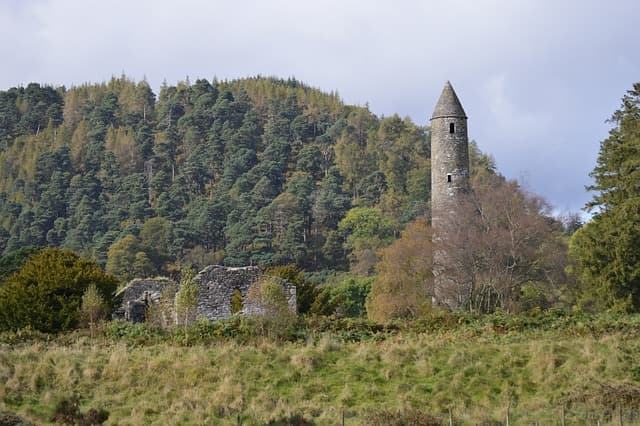
gown] Addenda (7 Octr) to the two foregoing entries. – Hideous crowds of beggars at Glendalough – offering guideship & c. No guide needed. Little black-eyed boy, beautiful orphan beggar, forces himself on us at last; ditto grey-eyed little girl, with fish her uncle had caught. Scarecrow boatman, his clothes or rags hung on him like tapestry, when the wind blew he expanded like a tulip: first of many such conditions of dress. “King O’Toole’s tomb”. “Tim Byrne” (Burn they pronounced), spoken to, he, the one whole-coated farmer of the place; many Byrnes hereabouts. Could not make out the meaning or origin of Glendalough; at last found St. Kevin (natural in St. K) to be the central fact: the “Kings” O’Toole, O’Byrne &c &c had dedicated chapels to him, bequeathing their own bodies to be buried there, as unspeakably advantageous for them; straight road to Heaven for them perhaps. Many burials still there; tombstones, all of mica-slate, slice off into obliteration within the century. One arch (there still remains another) of entrance to “Cathedral” had fallen last year (or year before?) Found, and miracles in “Patron-time”; “Patterun” is Kevin himself; “St. Kevin’s be your bed!” Brought heath and ivy from Glendalough; grimmest spot in my memory. Halverstown
a quiet original
little country-seat; beautiful in the summer greenness and all wearing
an
exotic look; “Irish Maecaenas”
kind
of air. Purcell, a notable Irishman, had run coaches, made a farm often at his coach station; this
was one. Mass-chapel in it (priest didn’t
appear); galleries, summer hall; dining room lighted
with glass dome;
number of tolerable pictures; - place added to gradually; very good; my
room
excellent. Greenhouse, pretty shrubbery with “big
stone” in it (Edd Fitzd’s);
trees round, children had a little coach with goats
harnessed; good order
reigning (or strenuously attempting to reign) everywhere. –
Kilcullen (near by)
has a Kildare
Railway; big blockhead,
sitting with his dirty feet on seat opposite, not stirring them for me,
who
wanted to sit there: “One thing we’re all agreed
on,” said he “we’re very ill
governed; Whig, Tory, Radical,
Repealer, all admit we’re very ill governed!”
– I thought to myself “Yes
indeed: you govern yourself. He that
would govern you well, would probably surprise you much my friend, -
laying a
hearty horsewhip over that back of your’s.”
“No smoking
allowed”; passengers had erased the “No.”
Coarse young
man entering, took out his pipe, and smoked without apology. Second
Class; went
no more in that – Carlow,
“ Wake
early, sound of jackdaws,
curious old room, two windows to street, one behind; tops of all come
down (not bottoms up, of all);
plentiful
thorough draft: look out over the grey old dilapidated town: smoke; to
bed
again, but sleep returns not. O’Shaughnessy (after letters
written &c.)
takes us out in Cane’s carriage to look over his poor-houses.
– Had seen the
“Market-morning” before; crowd of people under the
pillars, eggs, lean fowls
and other small-trash. – Coblers 3 or 4 working on the
street. – Letter to Jane
(to Mother next day. – Still
here), - on a very curious kind of
“table” (a hydrasting cylinder in fact), the only
one I had convenient!
O’Shaughnessy’s subsidiary poor-house (old
brewhouse, I think), workhouse being
filled to bursting: with some 8,000 (?) paupers in all.
Many women here; carding cotton, knitting, spinning
&
c.& c. place and they were very clean; - “but one can,” bad enough! In other
Irish workhouses, saw the like; but
nowhere ever so well. Big Church or
Cathedral, or blue stones, limestony in
appearance, a-building near this spot. Buttermilk pails (in this
subsidiary
poor-house, as in all over Workhouse;
huge chaos, ordered “as
one could; “-O'S., poor
light little Corker (he is from Other
stranger (snuffy editor now?) to
breakfast, admires Gray’s
Scheme, - Edin. Gray, a projector of money
schemes – to give all the world money
at
will, “do nicely for Breakfast with the Father Something; steepish street far back in the City; other younger Father with him; - clever man this, black-eyed florid man of thirty this, not ill informed, and appears to have an element of real zeal in him, which is rare among these people. Priest’s breakfast and equipment nothing special; that of a poor schoolmaster of the like, living in lodgings with a rude old woman and her niece or daughter: talk also similar, - putting Irish for Scotch, the thing already known to me. – To see some Charitable Catholic Schools; far off, day hot, I getting ill: Irish monk (pallid, tall, dull-looking Irishman of 50) takes us hospitably; 40 or 50 boys, all Catholic, with good apparatus – these he silently won’t set agoing for us (“holiday” or some such thing); we have to look at them with what approval we can. To the hotel, I with younger priest; totally sick and miserable when I arrive, take refuge up stairs on three chairs, and there lie, obstinate to speak to no man till our car go off. Currey does see me however; settles at last, - will do the impossible (tho’ unnecessary), and not be satisfied without doing it. Car at last (after Ld. Carew &c); in the hot afternoon still high we rattle forth into the dust. Dust,
dust, wind is arear of us
(or some dusty way it blows) on
the
car; and there is no comfort but patience, distant view
of green, and occasionally a cigar. The wind, dusty or
not,
refreshes, considerably cures my sick nerves, as it always does.
Straight dusty
places: goats chained together with straw-rope; “repale would
be agreeable!”
Scrubby ill-cultivated country; Duffy talking much, that is, making me
talk.
Hedges mostly of gorse, not one of
them will turn any kind of cattle, - alas I found that the universal
rule in Beautiful
breezy sunny morning;
wide waving wooded lawn, new cropt of hay;
huge square old grey mansion hanging on the woody brow or (Drown, Drum) over the river with steps, paths
& c cut in the steep; - grand silence everywhere, huge empty hall like a Cathedral when you entered; - all the
family away but Ld Stuart and a step-daughter
Baroness, semi-german, and married to a German now fighting against the
Hungarians (Baroness zealous for
him). The pleasantest morning and day of all my Tour. – Quiet
simple breakfast;
all in excellent order (tea hot & c as you find it rarely in
a
great house); my letter comes now
and
we have a nice quiet hour or two, we three, over this and other things;
ride
with Lord Stuart to gardens, thro’ woods to village of
Dromana; clean slated
hamlet with church; founded by predecessor (70 or 80 years ago) for weaving. Hooded monk |